
Marrakech North Africa, the “Red City” of Morocco, is a place of enchantment and mystique, steeped in a rich tapestry of history and culture. But beyond the well-trodden tourist path, there lies a world of untold stories, hidden gems, and unforgettable experiences waiting to be discovered by travellers who immerse themselves in the real Marrakech.
We embrace authentic travel. Engaging with new cultures, traditions and people enriches our lives and broadens our views. To immerse ourselves in Marrakech North Africa, we stayed in a traditional riad within the walls of the medina and explored the city’s tangled streets on foot.
In this article, we share our authentic travel experience in Marrakech North Africa. This is our untold story of hidden gems and unforgettable experiences. Join us on our journey into the city’s lesser-known corners and discover the sights, sounds and experiences (good and bad!) that awaited us.
Preparing for our Authentic Travel Experience in Marrakech North Africa
For us, a big part of authentic travel is making our own travel arrangements independently. Before we travelled to Marrakech, we did 3 things:
- Prepared a Rough Itinerary of Things to See and Do in Marrakech
Wherever we travel, we always start by mapping out a rough itinerary of places to visit and possible things to see and do. After that, we research public transport links for our route and accommodation options.
To help us plan our visit to Marrakech, we purchased the Lonely Planet Guide. We find these guidebooks a useful starting point as they contain suggestions about where to stay and what to eat for a range of budgets. In addition to information about the main tourist sites, they also have suggestions about lesser-known places to visit.
- Decided Where to Stay in Marrakech
To immerse ourselves in the heart and soul of Marrakech, we decided to stay in a traditional Moroccan riad – a multi-storey house designed around a central courtyard with a fountain. We used Booking.com and Airbnb to search for suitable riads located in the heart of the medina so that we could absorb ourselves in local life.
It was also important for us to choose a riad that included breakfast. In our experience, smaller, locally owned guesthouses serve a traditional breakfast. This enables us to discover and experience local food each morning – an essential part of authentic travel.
Knowing the streets of the medina are like a labyrinth, we tried to find the location of our riad before we arrived in Marrakech. Google Maps struggled to pinpoint the exact address, so we phoned the riad for help. After kindly refusing their offer of a taxi transfer from the airport, we managed to get a rough location of the riad using nearby landmarks and a promise that we would be met by a ‘Guardian’ – the Doorman.
- Researched Public Transport from Marrakech Airport to the Medina
Another important feature of authentic travel is to travel like a local using public transport. In addition to experiencing how locals travel, public transport is cheap, and it allows us to spend more money on things like entry fees to historical sites and food. Of course, using public transport also means that we interact with local people as we often need to ask them for help with timetables, tickets and transport locations.
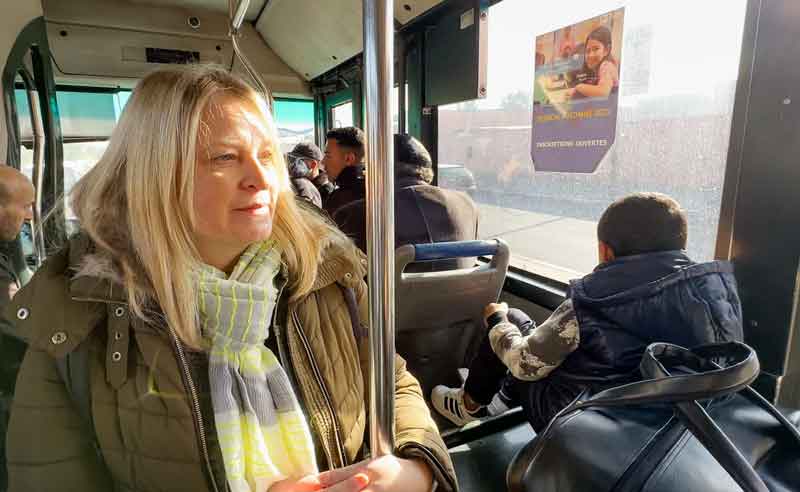
We always use internet searches and travel forums to start our public transport research. You might be surprised at how much information you can gather from your home! Before arriving in Marrakech, we knew that we could take either bus number 11 or 12 from the airport straight to the Marrakech medina.
Arrival in Marrakech
Marrakech’s modern airport is close to the city centre and is easily reached by public bus. After making sure our passports were stamped correctly, we asked a local for directions to the bus stop. Unsurprisingly, we were directed to the tourist shuttle bus!
Keen to avoid this, we eventually found the public bus stop via a very indirect route. Little did we know that we just needed to leave the arrivals door and walk straight ahead to reach the main road! However, one of the joys of authentic travel is getting lost and finding your way in another country.
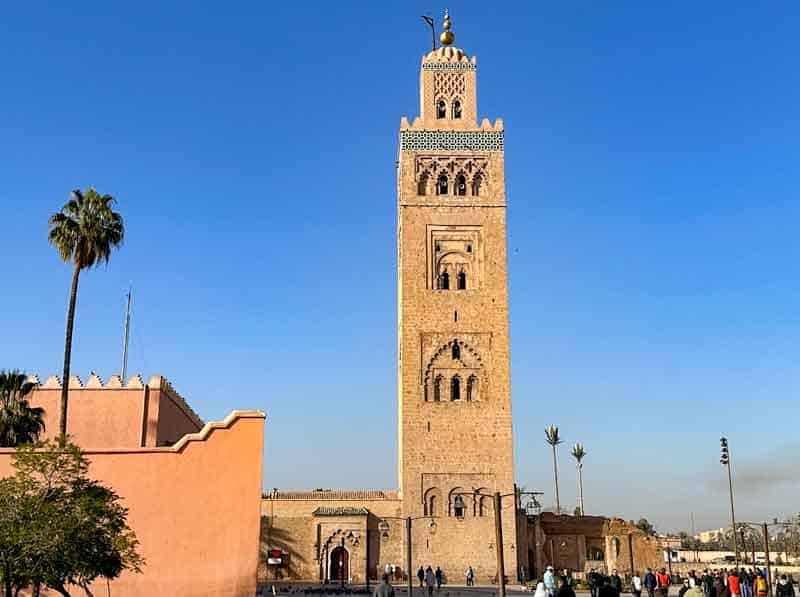
For just 4 dirhams (40 cents), the bus dropped us off in a very central position between two of Marrakech’s most famous landmarks – the Koutoubia Mosque and the Place Jemaa El-Fna.
First Impressions of the Medina Marrakech
As we navigated the city’s busy main square (Place Jemaa El-Fna), our senses were overwhelmed. Unfamiliar sights and sounds competed for our attention as we tried to safely dodge cars, carts and horses in the hazy light.
Even though it was early in the morning, locals were crouched in front of baskets practising the ancient art of snake charming. The notes from the Pungi wind instrument echoed hypnotically across the square competing with the cries of juice sellers perched high above dazzling arrays of exotic fruits.
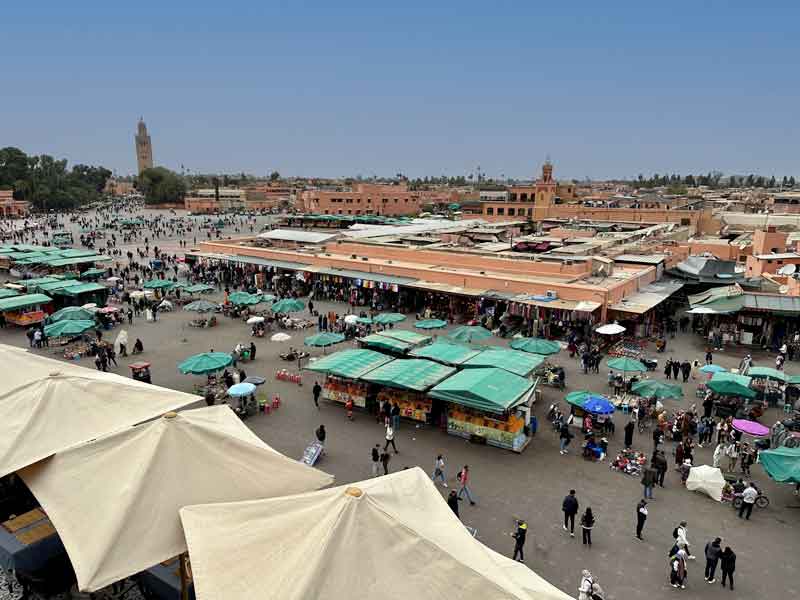
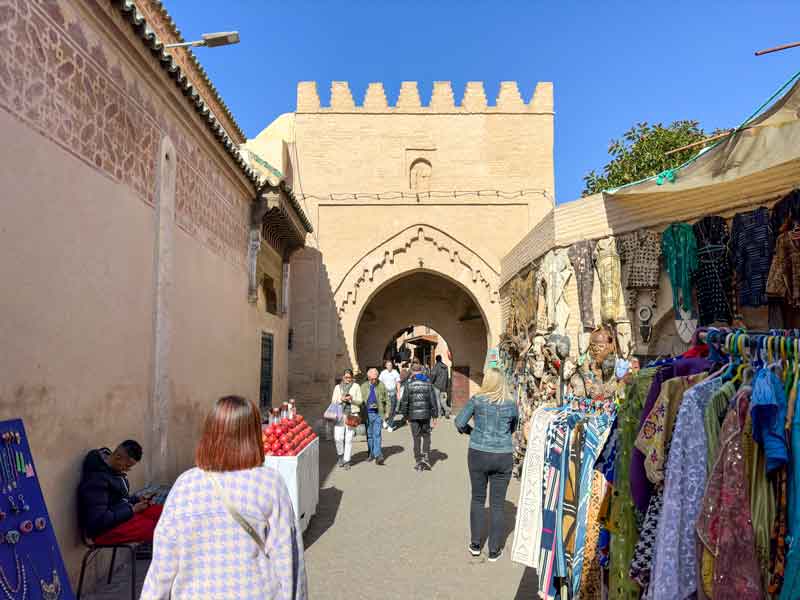
In a far corner of the Place Jemaa El-Fna, we entered the outskirts of the Marrakech souks. We soon found out that the medina is the most chaotic part of the city and an intense experience. Its narrow, confined streets were crowded with tourists and locals jostling for space.
Fumes lingered in the air from noisy motorbikes that somehow weaved their way through the chaos without incident. The smell of fumes was overpowering under the claustrophobic covered passageways, and we had to laugh about our efforts to reduce pollution by trading our diesel car for an unleaded model!
As we snaked our way through the alleyways, we hoped our printed map would lead us to our chosen riad in the depths of the medina. With no 4G (for a more authentic experience!) and not a street name in sight, we boldly continued past rows of narrow, cave-like shops sandwiched together as far as the eye could see.
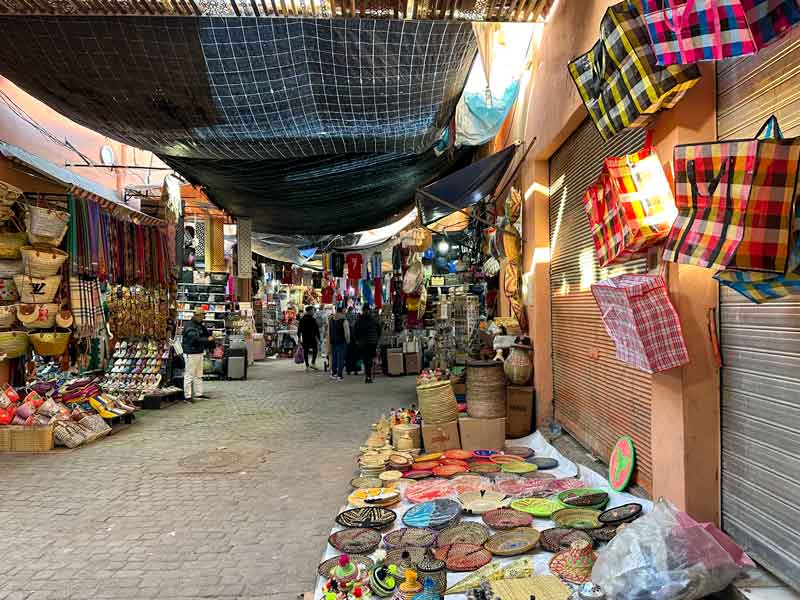
Like Aladdin’s cave, the tiny shops were overflowing with treasures from tourist-pleasing brightly coloured leather Babouche shoes and decorative plates to healthy-looking cuts of meat and pharmaceutical products for the locals. Words of Arabic filled our ears as men dressed in traditional hooded Djellaba robes swept past, greeting acquaintances in their path.
Eventually, we found ourselves in the Place Ben Saleh with its low soft-coloured terracotta buildings and attractive 14th century mosque and intricate turquoise minaret. The small square was buzzing with life. Locals leisurely chatting outside small corner shops in traditional dress, men sorting through bric-a-brac on the back of a hand-pulled cart, and a butcher getting ready for the day with unsuspecting chickens clucking in cages behind him.
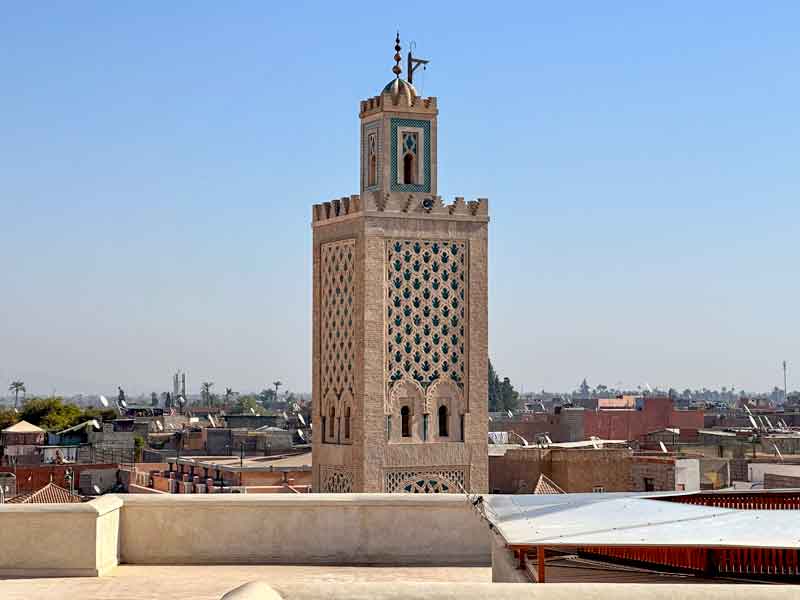
This part of the medina felt like another world. We felt like we were part of an action-adventure movie set as the noise of motorbikes filled the square and scattered locals and the occasional lost tourist. Whilst we waited, friendly locals offered to take us to our riad. However, our humble ‘guardian’ appeared as arranged. After exchanging a few simple greetings in Arabic and some words in French, he led us down an unassuming alleyway towards our home for the next few days.
Marrakech Riad
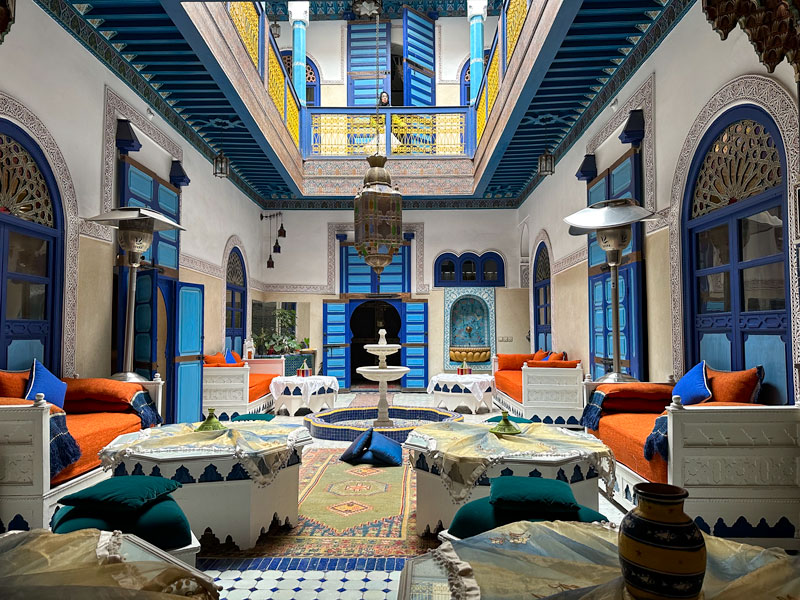
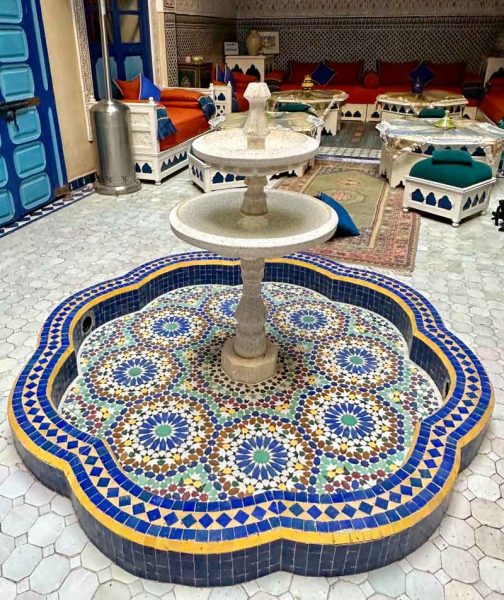
The riad did not disappoint. As the heavy door closed, the hustle and bustle of the medina was hushed and was replaced by the peace of a tiled central courtyard with mosaic fountain. Overhead hung a traditional Moorish lamp, beautiful inlaid wood joists and the inviting blue and yellow décor of the landings above. We were immediately transported to another time and immersed in the contrasting world of how the wealthy once lived.
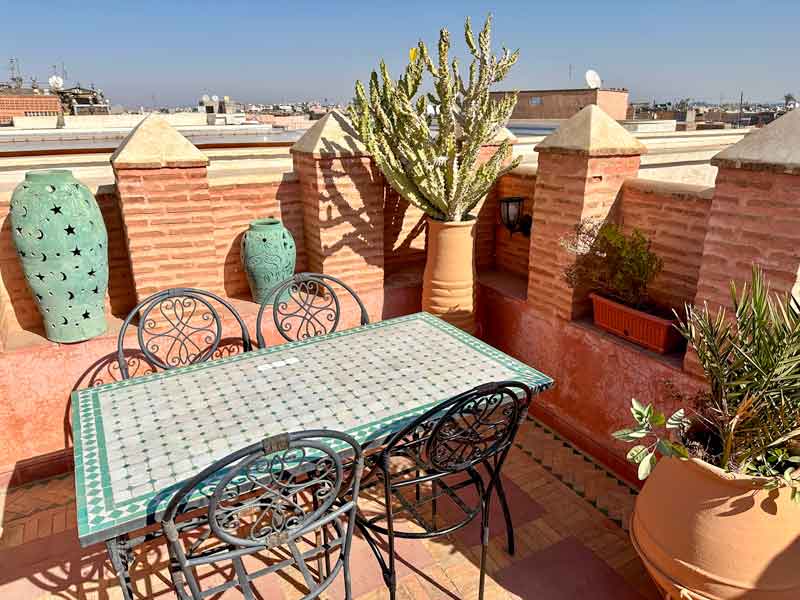
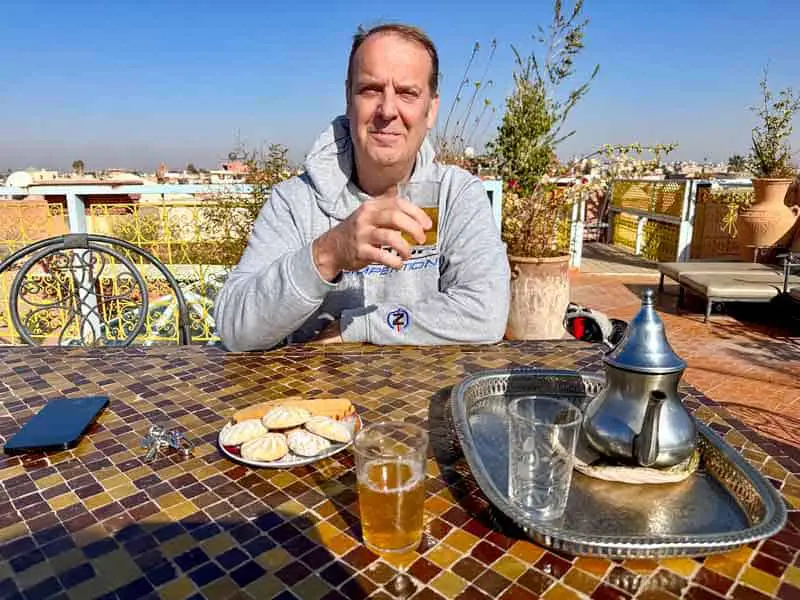
On the rooftop, our host appeared with a smile and refreshments. She skilfully poured sweet-smelling peppermint tea from a traditional silver teapot into small patterned glasses and encouraged us to try some local sweet treats. As we took in the magnificent view across the medina rooftops, we were surrounded by the calls to prayer which echoed from mosque to mosque across the city.
Exploring the Souks of Marrakech
One of the first things we did in Marrakech was to explore the many souks within the Marrakech medina. It was my first experience of a souk and I wasn’t sure what to expect.
From the Place Jemaa El-Fna, we were drawn into the busy Souk Semmarine that appeared quite tourist-orientated selling a little bit of everything including souvenirs, pottery, leather and metalwork goods.
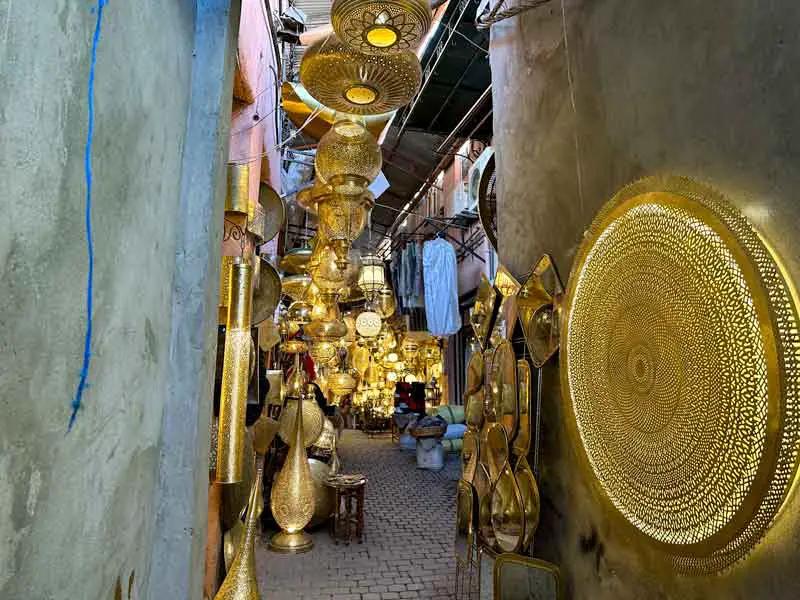
As we headed deeper into the souks, we get sucked into a never-ending warren of streets and alleyways that were overflowing with different merchandise. At first, the souks seemed like a jumble of shops. However, the further we walked, we realised that the souks were organised into districts with shops selling similar artisanal goods – leather, woodwork, metalwork, jewellery, textiles and carpets to name a few.
We took time to soak up the atmosphere and to admire the architecture of buildings within the souks. Amidst the shops, we discovered detailed mosaic facades, ornate arches and hidden squares. Of course, you can’t visit the souks without haggling, as this is an important part of Moroccan culture. After declining the first prices offered with a smile, we managed to get a fair price on some local artisanal goods.
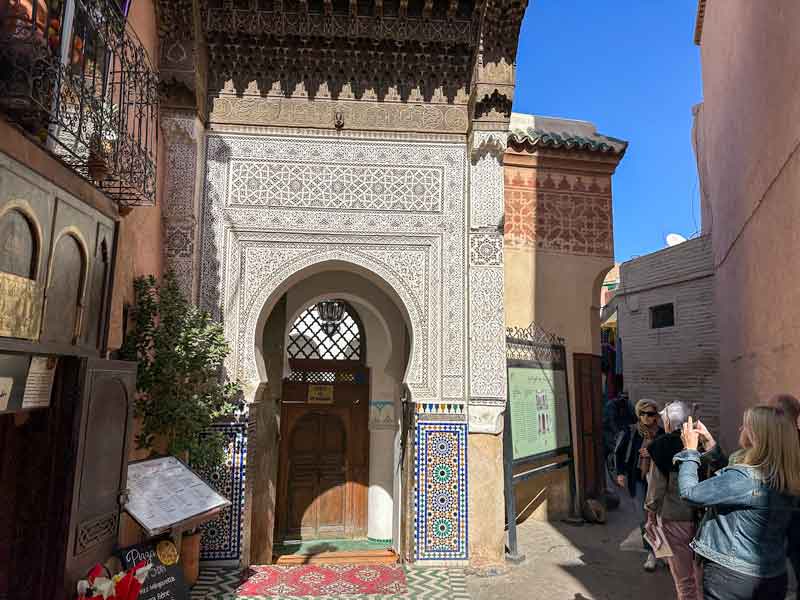
Of course, it’s easy to get lost in the winding streets of the souks. We embraced this as it helps make a travel experience more authentic. We love to discover new things by being adventurous and not always knowing where we are going!
Usually, we love to ask locals for help when we get lost. However, in Marrakech it soon became apparent that some locals in the souks were less trustworthy than others. To avoid being sent round in circles, returned to the Place Jemaa El-Fna or taken to the Tanneries, we stopped accepting ‘help’ from locals. In the end, we figured out that one way of avoiding being stuck in a dead end was to stick to the streets with motorbike traffic.
By chance, we stumbled on the Place des Épices in the Rahba Kedima square with its mountains of colourful sweet-smelling spices, sacks of dried flowers that spilled onto the square, and the more curious sight of tiny live tortoises.
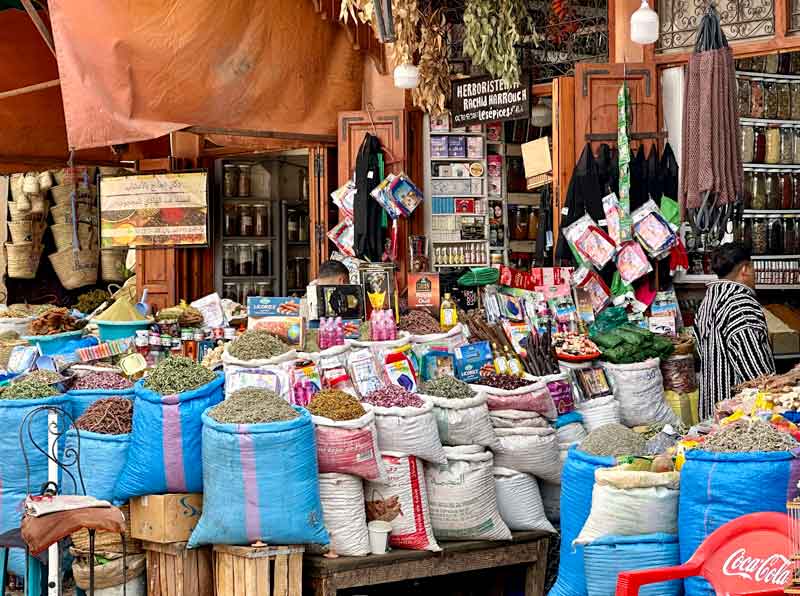
As we walked past, friendly spice sellers encouraged us to sample their goods and happily explained the health benefits of various spices and oils. A sniff of menthol crystals certainly cleared our sinuses for the day and Olivier is still chewing on his free liquorice root stick!
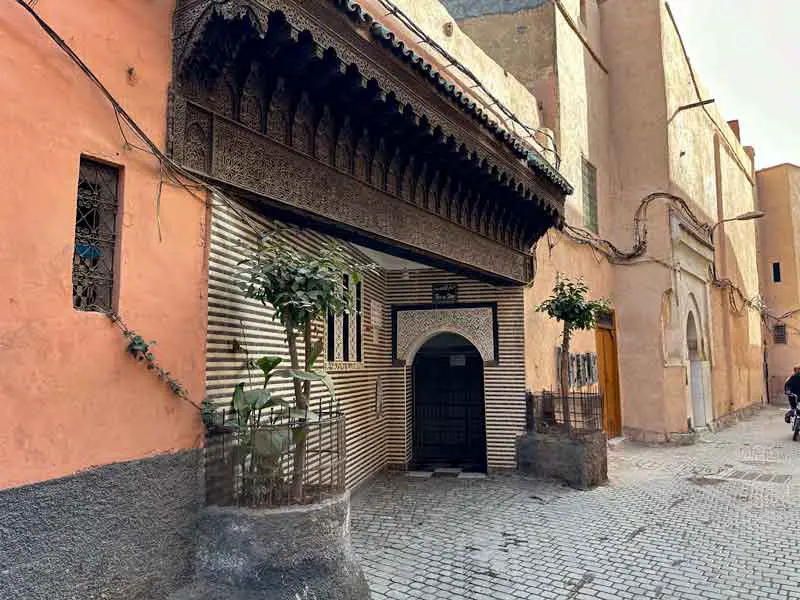
By exploring the souks on foot, we found many public hammam bath houses. Some were for men only and some catered for women. The locals running the hammams were very helpful and were willing to show us inside and describe the services they offered. Next to one hammam, we discovered its ‘engine room’ and met the man who was keeping the hot water running. His workplace was clearly his home as well, but he welcomed us in nevertheless and shared how everything worked.
Uncovering Marrakech’s Cultural Gems
Undoubtedly, the souks are one of Marrakech’s cultural highlights. However, within the Marrakech medina we explored many other historical sites that gave us an insight into the city’s past and other authentic cultural experiences.
The Koutoubia Mosque
The Koutoubia Mosque was the first place we visited on our arrival in Marrakech. As the largest mosque in Marrakech and its most famous landmark, the Koutoubia Mosque dominated the city’s skyline with its 250-foot-high minaret. We could even see it from the rooftop terrace of our riad which made for some great sunset pictures.
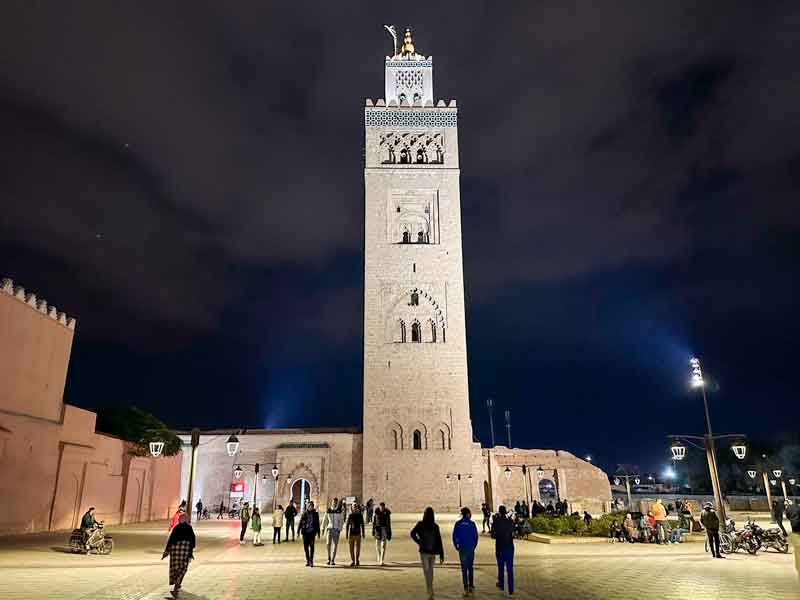
However, only Muslims can enter the Koutoubia Mosque. We happened to visit on a Friday when the doors are open for prayers, but this felt fairly intrusive, so we didn’t like to linger out of respect. Certainly, the square in front of the mosque and the Koutoubia Gardens behind were peaceful places to spend time away from the hectic medina.
Madrasa Ben Youssef (Ibn Youssef School)
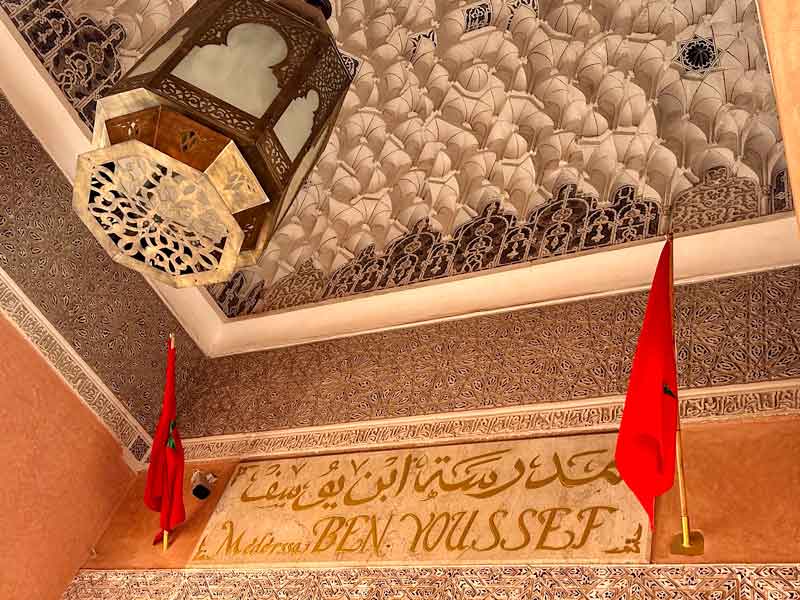
One way of gaining an insight into Marrakesh’s Islamic heritage is to visit the Madrasa Ben Youssef. This 14th century building was once an Islamic school and is located in the narrow streets of the northern medina.