
Rajasthan is known as the Land of the Kings. This state in north-western India is full of unforgettable places to visit. In this article, we share our tried and tested Rajasthan itinerary for 14 days to help you plan your visit and see the most of Rajasthan.
Our Rajasthan itinerary for 14 days features the cities of India’s Golden Triangle, the lakeside city of Udaipur and Ranthambore National Park. It includes visits to 10 of the best historical places in Rajasthan: Delhi-Mandawa-Bikaner-Jaisalmer-Jodhpur-Udaipur-Pushkar-Jaipur-Ranthambore-Agra.
Our tried and tested Rajasthan itinerary for 14 days is full of detailed information and maps about the route we took around Rajasthan. It also highlights the best historical places in Rajasthan to visit (with video guides) and helpful information about where to stay in Rajasthan.
Off the Tourist Treadmill’s Rajasthan Itinerary for 14 Days
By following our Rajasthan itinerary for 14 days, you will visit 10 unforgettable historical places in India:
Delhi – Mandawa – Bikaner – Jaisalmer – Jodhpur – Udaipur – Pushkar – Jaipur – Ranthambore – Agra – Delhi
Here is a map of our Rajasthan itinerary for 14 days.
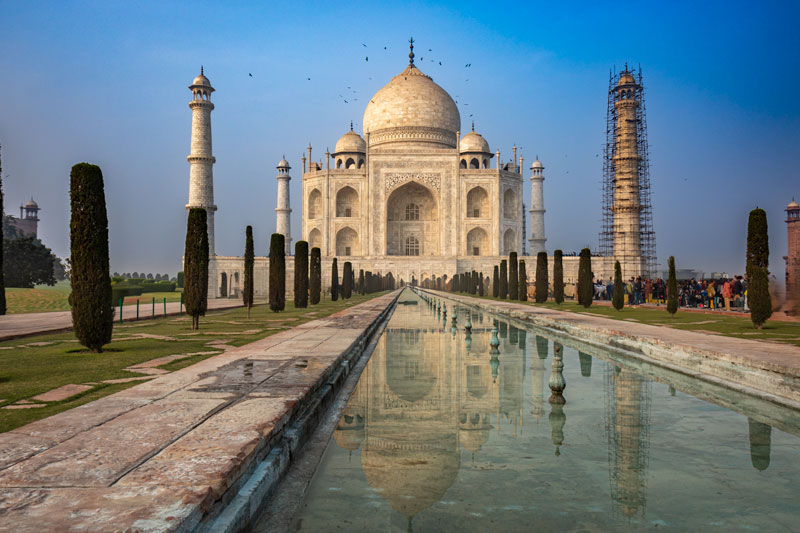
Our Rajasthan itinerary for 14 days starts and ends in India’s capital city of Delhi. Your journey includes a visit to Agra in Uttar Pradesh. No first visit to northern India is complete without a glimpse of the Taj Mahal!
Watch our YouTube video to see some of the historical places you will visit during our suggested Rajasthan itinerary for 14 days:
We hired a driver for our road trip around Rajasthan. He was our local guide and fixer. His expert knowledge meant we experienced some hidden gems along the way. You can find more information about this at the end of our post.
If you decide to travel by train, it is advisable to book your first-class tickets in advance to avoid disappointment.
Day 1 – Mandawa, Rajasthan
Our driver met us at the Indira Gandhi National Airport in Delhi.
Here is a map from Delhi to Mandawa.
It’s worth knowing that it will take you longer than shown to reach each destination. The state of the roads restricts the speed at which you can travel.
Our first stop on our Rajasthan itinerary for 14 days was Mandawa, a lesser-known town in the north of Rajasthan in the Shekhawati region. It probably wouldn’t feature on a typical Rajasthan tourist map, but we came here to explore traditional ‘havelis’.
What to See in Mandawa, Rajasthan
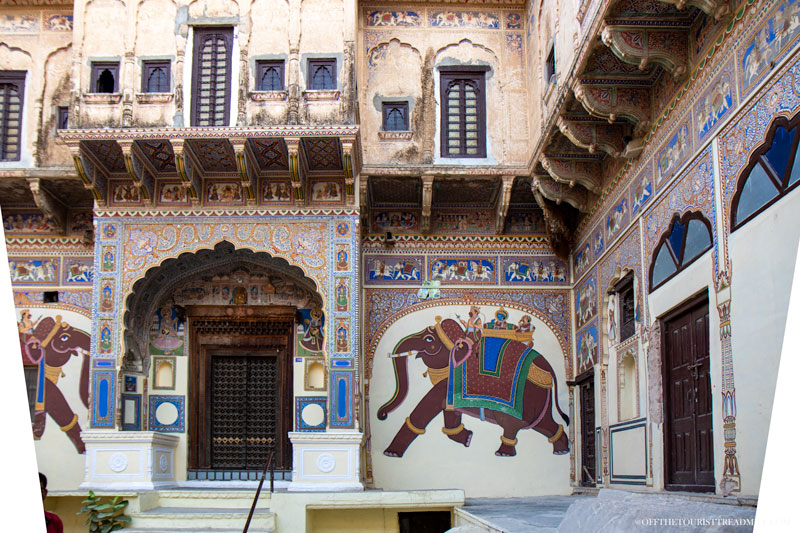
During the 17th to 19th centuries, wealthy merchants built grand ‘havelis’ in this region which are traditional town houses or mansions. In addition to being homes, havelis were also displays of wealth and were richly decorated both inside and out with painted murals.
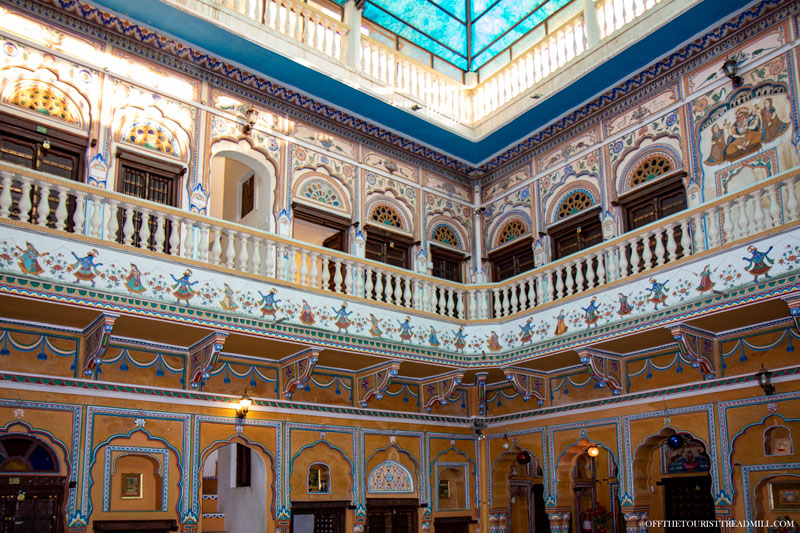
To experience the havelis in Mandawa, we opted for a walking tour with a guide. Many are being restored as they are falling into decay. Even so, the fading beauty of these havelis is intriguing.
Painted murals depict English and Indian culture and are reminiscent of Italian frescoes. The design of these havelis is as well-thought out as the decorative facades. Most had inner courtyards for women and outer ones for men to prevent women from being snatched by the local Maharaja!
Where to Stay in Mandawa, Rajasthan
Fittingly, our home for the night was the Hotel Shekhawati ($15 per night – approximately £12). This was an ancient haveli covered in faded painted murals which now offers basic but clean and welcoming accommodation.
In the early hours of the morning, we were awoken by unfamiliar chanting. First the call to Muslim prayer, then the call to Hindu prayer. Sweet Masala Chai (tea) on the roof is the only solution at this hour of the morning!
Mandawa has an approximate Hindu population of 15,000 and a Muslim population of 10,000. Both communities live respectfully side by side. Quickly, you realise the deep spirituality and tolerance of India.
The early morning chants are broadcast by loudspeakers across towns and cities. They soon become a familiar sound and constant companion on your journey around Rajasthan.
Day 2 – Bikaner, Rajasthan
The drive to Bikaner was hair-raising at times. Roads in India are like nothing we’ve ever experienced before. Flooded roads like rivers, non-existent roads, roads under construction or even roads through construction sites! Regardless of what lay in its path, the Suzuki Swift faithfully carried on and followed the route!
Here is a map from Mandawa to Bikaner
You can experience the roads in India for yourself by watching our entertaining YouTube video:
What to See in Bikaner, Rajasthan?
Bikaner is a city situated in the Thar desert. It’s a hectic place full of blaring horns, cars, buses, trucks, tuk-tuks, people and animals jostling for a place on the roads. Off the main street is a bustling labyrinth of bazaars selling anything and everything. Bikaner is also known for its famous Junagarh Fort.
Junagarh Fort, Bikaner
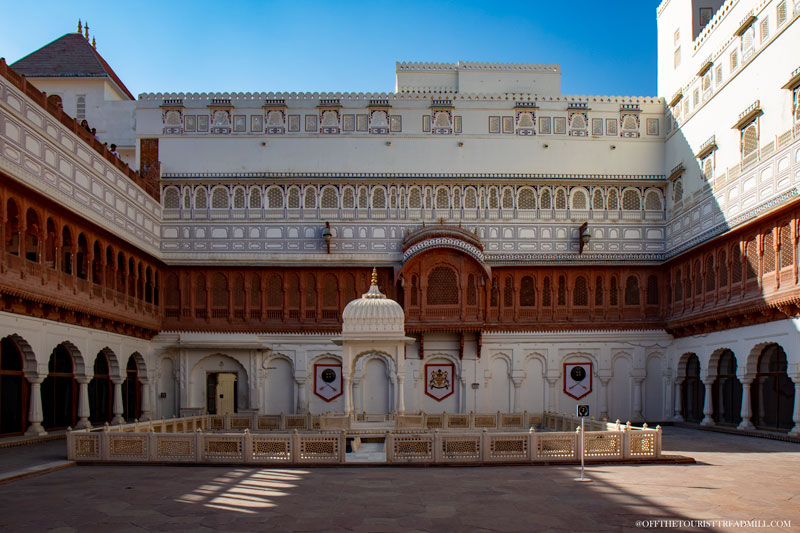
Visiting Junagarh Fort was our first experience of the impressive forts in Rajasthan. This red sandstone fort was built for the Royal Family of Bikaner. It remained almost unconquered during its history despite not being built on a hilltop.
The fort has stunning palaces, courtyards, pavilions and balconies. Its walls are adorned with carved stone, marble, mirrors, paintings and inlaid precious stones.
Rat Temple (Karni Mata Temple), Deshnoke, Rajasthan
If you want a truly unique experience, 30km outside of Bikaner at Deshnoke is the Karni Mata Temple. It is also known as the Rat Temple!
This is an extraordinary temple crawling with thousands of sacred rats. It may not be high on your list of things to see in Rajasthan, but it’s a fascinating sight to behold.
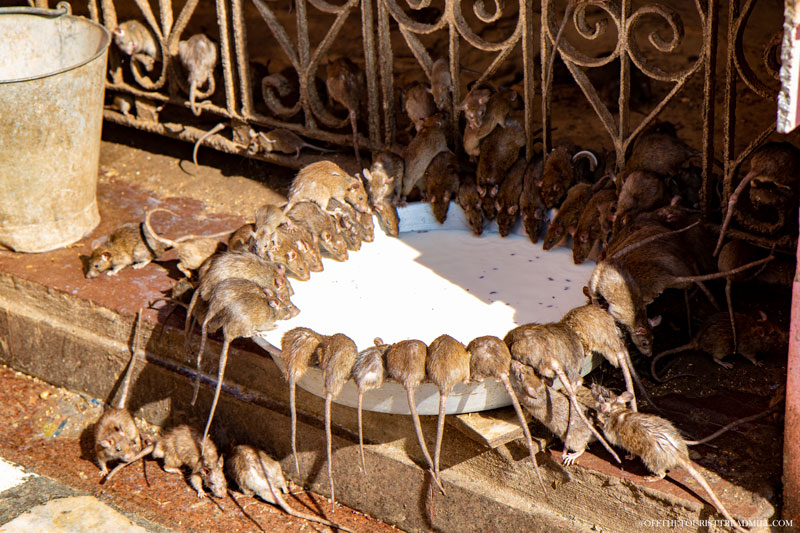
This Hindu temple is dedicated to Karni Mata (an incarnation of the Hindu warrior goddess, Durga). Locals worshipping here believe that the rats are kaabe (reincarnations of Karni Mata’s devotees). They are fed by descendants of the Depavats family.
Worshippers and visitors mingle together in this unusual place. No shoes are allowed in the temple, so take a spare pair of socks to wear if you are visiting.
If a rat runs over your feet or if you see an albino rat, it is considered lucky. However, tread carefully! According to temple law, any rat accidentally killed must be replaced by a rat made of gold or silver!
Here is a map from Bikaner to Deshnok.
Where to Stay in Bikaner, Rajasthan?
In Bikaner, we stayed at the Hotel Sagar ($51 – approximately £40).
A short walk along the road from our hotel, we found the Laxmi Niwas Palace. This is a red sandstone palace. It used to be the residential palace of the former King of Bikaner state. Visitors are welcome to stroll around the interior of this luxury hotel.
Day 3 & 4 – Jaisalmer (Golden City), Rajasthan
The journey by car from Bikaner to Jaisalmer is 6 hours. The route was unremarkable and the roads were unfinished.
Here is a map from Bikaner to Jaisalmer
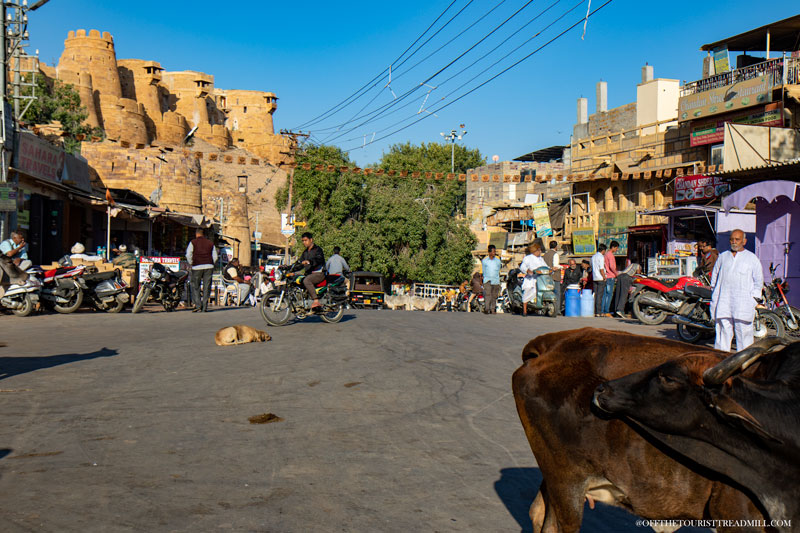
Jaisalmer or Golden City is situated in the Thar desert. The impressive Jaisalmer Fort is one of the Hill Forts of Rajasthan protected as a UNESCO World Heritage Site.
The city of Jaisalmer is built on a ridge of yellow sandstone. It is crowned by Jaisalmer Fort which looks like an enormous sandcastle. Within the fort’s walls are many palaces, residential dwellings and impressive Jain temples.
What to See in Jaisalmer, Rajasthan?
We spent two nights here as there are many interesting things to see and do in Jaisalmer.
Camel Ride in the Thar Desert, Rajasthan
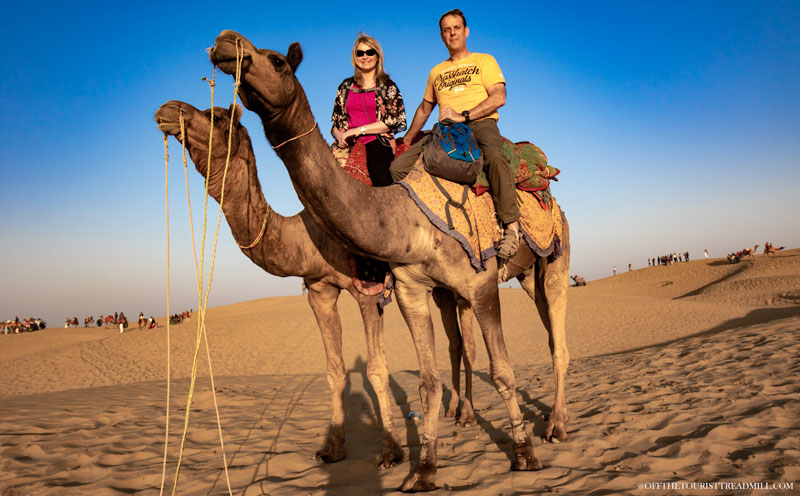
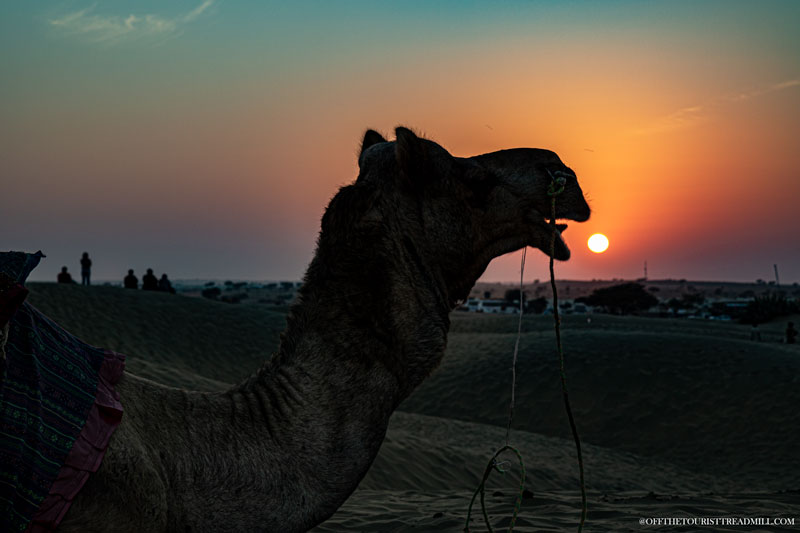
On our first evening in Jaisalmer, our driver arranged a sunset camel ride in the Thar Desert. Don’t have visions of being in the Thar Desert on your own! This is a serious commercial tourist operation.
Nevertheless, we had a majestic ride into the desert sand dunes. Our camel guide soon left the train and found us a quiet spot to watch the sunset alone. Michael Jackson (my camel!) had a rest while we enjoyed a cold beer (delivered by a runner!) and a stunning sunset.
Gadsisar Lake & Tilon-Ki-Pol (Gate of Tilon), Jaisalmer
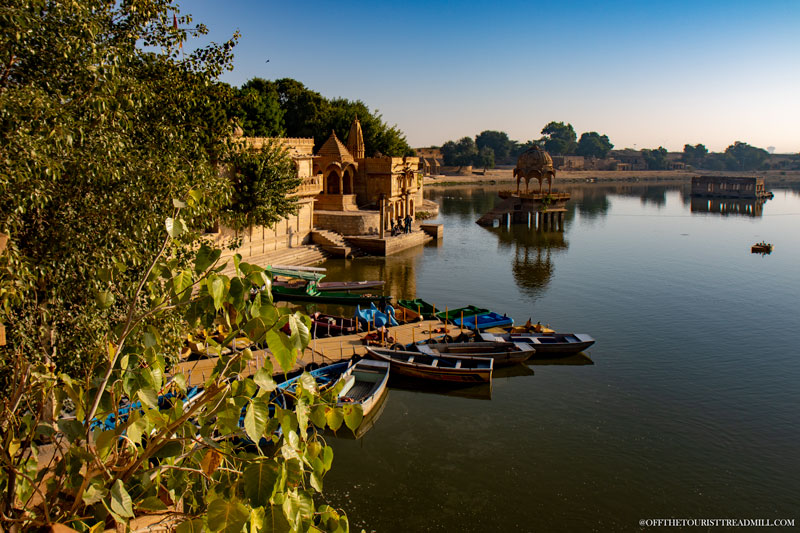
Early in the morning, we visited the incredibly scenic Gadsisar Lake. This is an artificial lake made by the Maharaja around 1400 AD. The vast reservoir was built to trap rainwater and supply the arid desert city of Jaisalmer.
Access to the lake is through the Tilon-Ki-Pol (Gate of Tilon) which was built by a rich royal courtesan, Tilon. Originally, the King refused permission for her to build the gate. He felt it would be beneath him to pass under the gate to reach the lake.
Defiantly, she still built the gate! To avoid it being demolished, she put a temple on top. Apparently, today’s Royal Family still refuse to go through Tilon-Ki-Pol.
Jaisalmer Fort, Rajasthan
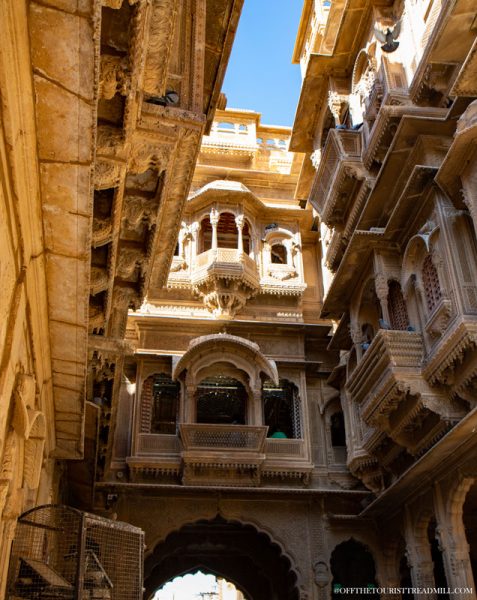
On this occasion, our driver arranged a guide for us to explore this sandstone structure with its maze of streets. Incredibly, Jaisalmer Fort is constructed by blocks of sandstone with no cement.
There is only one way in and one way out of Jaisalmer Fort. To enter, you pass through four gates. Intricate carvings adorn many of the buildings inside. Many of the 4,000 residents of the fort are direct descendants of the city’s former warriors and priests. There is no escaping the history of this place, it’s steeped in the past.
Chandraprabuh Temple, Jaisalmer
Make sure you don’t miss out on visiting Chandraprabhu. This stunning Jain temple was built in 1509. It was the first of seven temples built within Jaisalmer Fort in the 15th and 16th Centuries.
The temple’s intricate carvings, corridors and ceilings are amazing. Look out for the statues of the 24 Jain prophets. These are housed in individual recesses around the temple.